MathWays
- Does Math Matter?
- Placement and Pathway
- Math Acronyms
- Math and Your Major
- Modified Major Plans
- Success Tips and Truths
- Math Resources
When you enter UC San Diego, an accurate math placement is crucial. It determines in which class you start, how many math courses you will need, and ultimately how long your graduation path will be.
There is no "good" or "bad" placement! We want to make sure you are most prepared to be successful in the math course where you start.
If your major or College requires calculus courses, you must prioritize Math courses from your first quarter and progress each quarter.
Are you a current student looking for placement options for your current situation? Use this resource to understand your options.
START: The course where you place. Learn how to get your math placement.
FINISH: The last course needed for your major and College. Explore major and College requirements.
[Click to open PDF of Math Path Flowchart with clickable hyperlinks]
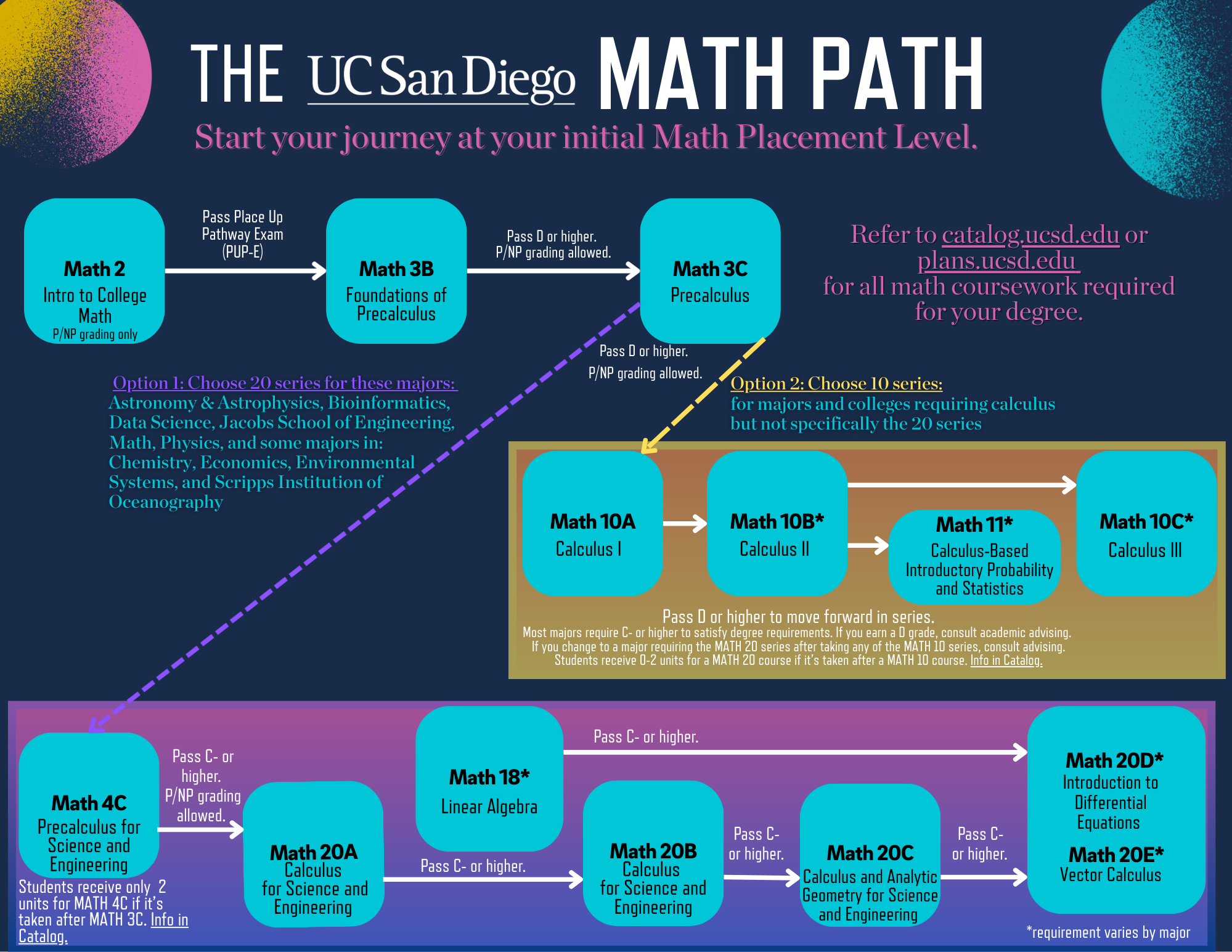
Find course information in the university catalog
Review the math department's planned course offerings
Some students may want to take math courses at another institution and transfer them to UCSD. Read about options below.
The course must be equivalent to MATH 10A or MATH 20A to earn calculus credit at UCSD. See UCSD Math transfer equivalencies for options. No transfer course is directly equivalent to UCSD's MATH 2, MATH 3B, MATH 3C, or MATH 4C. (Skip to Option 2 below if you are not yet ready to take calculus at a community college).
To enroll in a calculus course for transfer, you will need to apply directly to the community college. See Enrollment Guidance for Community College Coursework below.
Tips:
After you pass the MATH 10A/20A course, you can enroll in the next course in the sequence at UCSD (MATH 10B/20B). You will need to submit an enrollment authorization request if the final grade is not yet posted on your UCSD Academic History at the time of enrollment.
| Example: King Triton places into MATH 3C but decides to take calculus and a support course at a community college. He enrolls in MATH 121 + MATH 85 (Applied Calculus I, plus Support for Applied Calculus) at Southwestern College. He passes the courses, submits his transcript to UCSD, and earns 4.5 units of credit for MATH 10A, plus 3.5 elective units. He enrolls in MATH 10B at UCSD the following quarter. (OR, he enrolls in MATH 122 at Southwestern College the next semester to finish the calculus sequence there, equivalent to MATH 10A-B-C at UCSD). |
No transfer course is directly equivalent to UCSD's MATH 2, MATH 3B, MATH 3C, or MATH 4C. Many preparatory math courses before calculus (e.g., algebra, geometry, trigonometry, precalculus) are not UC-transferable for credit. You can see if the course is UC-transferable for credit by visiting assist.org. If the course is UC-transferable, you will earn elective credit (toward the 180 units needed for your degree). Even if the course is not transferable for UC degree credit, preparatory math courses at a community college are a great low-cost option for students who want a traditional class experience and need more preparation.
Examples:
You will need to apply directly to the community college where you want to enroll. See Enrollment Guidance for Community College Coursework below. You must submit a final transcript to UCSD Admissions once the course is finished.
If the course you take is not yet equivalent to the calculus level (equal to MATH 10A or 20A), you must retake the UCSD Math Placement Exam (MPE) to enroll in a future math course at UCSD. Contact mathtesting@ucsd.edu with proof of passing the course (such as an unofficial transcript with your final grade) to request to retake the MPE.
|
Example 1 (MATH 2 initial placement) Rory places into MATH 2 and decides to take MATH 110 (College Algebra) at Palomar College. They talk with Palomar College counselors about enrolling. They pass the class, submit their transcript to UCSD, and earn 6 units of elective credit. They contact Math Testing & Placement to retake the UCSD Math Placement Exam (MPE) in September. They place into MATH 3B and enroll in MATH 3B in Fall. |
|
Example 2 (MATH 3B or higher initial placement) Ell places into MATH 3B and enrolls in MATH 141 (Precalculus) at San Diego City College. They work with City College counselors to enroll and pay for the course. They earn a D in the class, send their transcript to UCSD Admissions, and earn 6 units of elective credit. They contact Math Testing & Placement to retake the UCSD Math Placement Exam (MPE) in September and place into MATH 3B again. They will need to take MATH 3B at UCSD in the Fall quarter, OR they could enroll in the subsequent course at City College in the Fall quarter and consider finishing all courses in the Calculus sequence there. |
This option is for students who place into MATH 2. Plan to spend at least 100 hours studying before taking the PUP-E. To self-study without a formal course, try this:
After self-study, you must register for the MATH 2-to-3B Place-Up Pathway Exam (PUP-E) when it is next offered and pass the exam to place into MATH 3B. If you pass the MATH 2-to-3B PUP-E and believe you can place even higher, you may take the MATH 3B-to-3C PUP-E right away.
| Example 1: Parker places into MATH 2 but cannot take a summer course at a community college because of their job. They spend 5-10 hours every week using Khan Academy throughout the summer. They take the PUP-E for MATH 2-to-3B at UCSD in September and pass. They enroll in MATH 3B in Fall. |
| Example 2: Taylor places into MATH 2 and believes they just need a refresher from what they learned in high school. They spend a couple of hours watching YouTube videos and then take the PUP-E for MATH 2-to-3B in September. They do not pass the PUP-E. They should enroll in MATH 2 in Fall. (They are allowed to try to self-study again or take a community college course in Fall instead of enrolling in the course at UCSD, but they will need to pass the PUP-E for MATH 2-to-3B in the Fall quarter to be able to enroll in MATH 3B.) |
If you decide to enroll at a community college, follow these steps to help you navigate the process.
Most community colleges are on a semester calendar and meet for about 15 weeks, but UC San Diego uses the quarter system which is 10 weeks for each class. Look carefully at the course dates, as these will not match the dates of UCSD's quarters. To convert semester units to quarter units (if the class is UC-transferable for credit), multiple the semester units by 1.5.
Example: A 4-unit class at a community college on the semester system is 6 units of credit at UCSD.
If you have questions about enrolling at a community college, you will work with that community college's advising/counseling team. You may need to take a placement exam or provide test scores or unofficial transcripts in order to enroll. All prerequisites and enrollment requirements are enforced by the community college, and UCSD placement exams do not have any influence over enrollment at other schools.
You will pay the community college directly via their bursar/student accounts office. Your UCSD financial aid will not cover the cost of the course. You may need to submit your FAFSA information to the community college to be eligible for aid. Contact the community college's financial aid office with any questions.
Visit the community college's Registrar/Records unit or use their online portal to order a final transcript once your final grade is assigned. Submit the final transcript to UCSD Admissions - view UCSD Admissions FAQ for full information of where to send the transcript either electronically or via mail.
If the course you took is not equivalent to the calculus level (equal to MATH 10A or 20A, or higher), you must retake the UCSD Math Placement Exam (MPE) to enroll in the next math course at UCSD. Contact mathtesting@ucsd.edu with proof of passing the course (such as an unofficial transcript with your final grade) to request to retake the MPE.
If the course you took is equivalent to a math course at UCSD, you can enroll in the next course in the sequence (if needed for your major) without retaking the MPE.
Review the Math Testing & Placement FAQ and contact mathtesting@ucsd.edu with questions.